
International Day of Clean Air for Blue Skies: What Do Your Cleaning Products Have to Do With Air Quality?
When we hear “clean air,” most of us think about what comes out of vehicles, factories, construction sites or power plants. But there is another side of air quality that deserves more attention. What about the products we use indoors to make things “clean”? We spray air fresheners. We use bathroom cleaners. We scrub floors with strong chemical formulations. We use disinfectants and multipurpose cleaners. The room may look spotless afterwards. But is clean-looking the same as healthy? This International Day of Clean Air for Blue Skies, it is worth looking beyond outdoor pollution and asking a simple question: Can we clean our spaces without unnecessarily adding chemical emissions to the air around us?
That is where the conversation around VOCs, safer cleaning formulations and bio-enzyme technology becomes important.
What Are VOCs and Why Should We Care?
VOC stands for Volatile Organic Compound.
These are carbon-based chemicals that can evaporate into the air at room temperature. VOCs can come from many everyday sources, including paints, adhesives, furnishings, solvents and some cleaning and fragranced products. You may not always see or smell them.
And that is exactly why indoor air quality can be easy to overlook. According to the U.S. Environmental Protection Agency, indoor concentrations of some pollutants can be higher than typical outdoor concentrations because pollutants can accumulate indoors, particularly when ventilation is limited. This doesn't mean that every cleaning product containing a VOC is automatically dangerous, or that every VOC-free product is automatically harmless. It means we should become more thoughtful about what we bring into the spaces where people spend hours every day. Because cleaning should not have to mean simply replacing one problem with another.

The Hidden Question Behind “How Clean Is Clean?”
Imagine an office bathroom.Someone complains about an unpleasant smell. The immediate response?Spray more fragrance.The smell disappears. For a while. But the underlying source may still be there. This is an important distinction:Masking an odour ≠ removing its source. A strong fragrance can make a space feel cleaner because our nose detects a pleasant smell. But real cleaning should focus on removing the dirt, organic residue and odour causingcompounds responsible for the problem in the first place. That is one reason bio-enzyme cleaning technology is gaining attention as an alternative approach.
We clean our homes, offices and washrooms every day. We spray, scrub and wipe until everything looks spotless and then we call it “clean.” But have we ever stopped to ask, what did we use to make it clean? A strong fragrance doesn't necessarily mean a cleaner washroom, and a powerful chemical doesn't automatically mean a better clean. At Ekam Eco, we believe the goal should be more than removing dirt it should be creating clean spaces without leaving behind unnecessary chemical residues, harsh fumes or environmental impact. That’s the thinking behind Zerodor Care our range of plant-based, enzyme-based cleaning solutions designed for effective everyday cleaning while being kinder to people, pets and the planet.

From toilet and floor cleaners to multipurpose cleaners, dishwash gels, drain cleaners and hand washes, Zerodor Care takes a different approach to everyday cleaning. Instead of simply masking odours with strong synthetic fragrances, enzyme-based formulations help break down the organic matter that can cause unpleasant smells. With formulations free from VOCs, bleach, chlorine, petroleum solvents and synthetic fragrances, Zerodor Care is built around a simple idea: clean shouldn't just look clean it should feel like the better choice for the space, the people in it and the planet outside it. Because when we clean, what we don't leave behind matters just as much as what we remove.
So, What Exactly Are Bio-Enzymes Cleaners ?
Bio-enzyme-based cleaners use enzymes and naturally derived ingredients to help break down organic matter responsible for dirt and odour. Think of enzymes as tiny biological tools.Instead of simply covering up an unpleasant smell, the formulation is designed to work on the organic material that contributes to it. When these residues aren't properly removed, they can contribute to persistent odours. A bio-enzyme approach focuses on the source of the problem, rather than relying only on strong fragrance to make the environment smell different. For example, organic residues can accumulate in:
Bathrooms
Floors
Kitchen surfaces
Drains
Toilets
Waste areas
High-traffic commercial spaces

Why VOC-Free Cleaning Matters
There is an important difference between “strong-smelling” and “strong-performing.” For decades, consumers have often associated a powerful chemical smell with cleanliness. But a clean bathroom doesn't need to smell like a chemical laboratory. A better cleaning philosophy is:Remove the dirt. Break down the organic residue. Control the odour. Leave the air alone. For indoor environments, choosing products formulated without VOCs can be one part of a broader strategy for reducing unnecessary chemical emissions from cleaning activities. And this becomes even more relevant in spaces with:
Limited ventilation
High occupancy
Children
Pets
Sensitive users
Long operating hours

Bio-Enzymes vs. Traditional “Strong Chemical” Thinking
This isn't about declaring every conventional cleaning product bad. Different cleaning situations require different formulations. Disinfection, sanitation and cleaning are also different processes and should not be confused. The real opportunity is to stop assuming that more aggressive chemistry automatically means better cleaning. A bio-enzyme cleaner takes a different approach. Traditional mindset:“Use something strong enough to kill or overpower the smell.”Bio-enzyme mindset:“Identify what is causing the dirt or odour and use biology to help break it down.”That shift may sound small. But it represents a much bigger change in how we think about everyday cleaning.

At Zerodor Care, the idea is simple:Cleaning should care for people, surfaces and the environment at the same time. The Zerodor Care range uses plant-based and enzyme-based formulations designed for everyday cleaning applications. The formulations are positioned around a cleaner alternative to conventional chemical-heavy cleaning approaches, with products designed to be VOC-free and plant-based. The goal isn't to make cleaning complicated. It is to make a better everyday choice easier. The range includes products for:
Hand washing
Dishwashing
Floors
Toilets
Drains
Multipurpose cleaning
Air and car freshening
Clean Air Starts With More Than Blue Skies
International Day of Clean Air for Blue Skies is primarily a reminder of the importance of clean air and the need to address air pollution. But the conversation shouldn't stop at the window. For the average person, a large part of daily life happens indoors. We work indoors. We study indoors. We sleep indoors. We eat indoors. We clean indoors. So air quality is not just an environmental issue. It is an everyday lifestyle issue. The choices we make about paints, fragrances, cleaning products, ventilation and building maintenance can all contribute to the indoor environment. No single product can solve air pollution. But thousands of small choices can move us in the right direction.
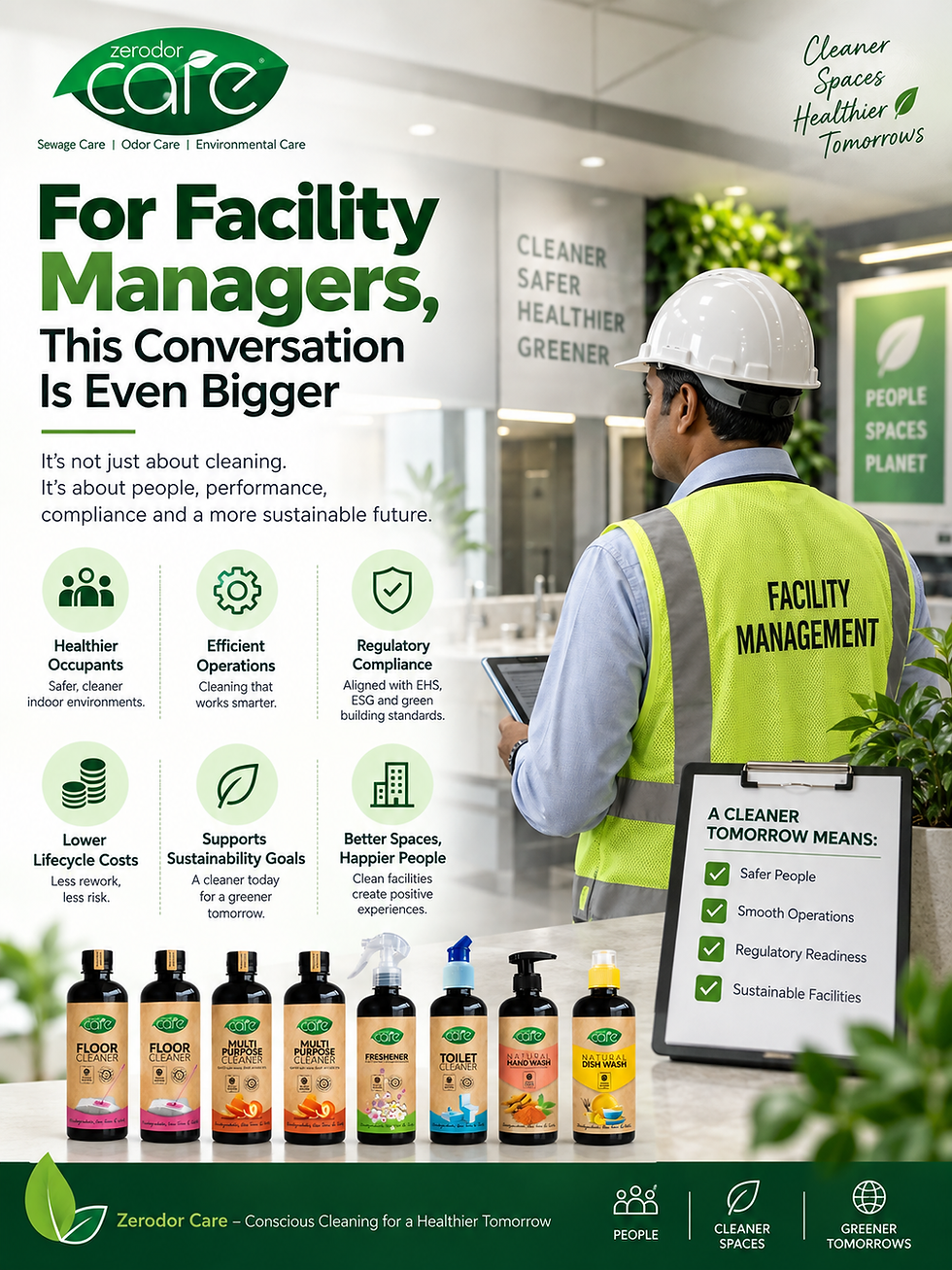
For Facility Managers, This Conversation Is Even Bigger
For a facility manager, cleaning isn't an occasional activity.It happens every day. Sometimes several times a day.In a large commercial building, the choice of cleaning products affects not just one household but potentially hundreds or thousands of people who use the facility. That makes product selection an important part of responsible facility management. more thoughtful cleaning strategy can include:
1. Choose lower-emission formulations where appropriate
Look beyond cleaning power and consider what a product releases into the indoor environment.
2. Don't use fragrance to hide persistent odours
Find the source first.
3. Read the label
Understand what you are bringing into occupied spaces.
4. Use the right product for the right job
More product doesn't necessarily mean better cleaning.
5. Improve ventilation
Product selection is only one part of indoor air quality management.
6. Train housekeeping teams
Correct dosage, application and storage matter as much as the product itself.
7. Think beyond cleaning
Waste management, drainage, sanitation and moisture control also influence indoor environmental quality.
The Future of Cleaning May Be Less About “More Chemical” and More About “Smarter Chemistry”
For years, the cleaning industry has largely competed on one question:
That means looking at the entire cleaning experience.
Does it effectively remove the target soil?
Does it help control odour at its source?
What ingredients does it contain?
What happens after use?
Is it appropriate for the people and spaces around it?
Can we reduce unnecessary chemical exposure without compromising the cleaning outcome?
These are the questions that can help move cleaning from simply being about appearance to being about well-being and sustainability.
Clean Spaces. Cleaner Air. Better Choices.
On International Day of Clean Air for Blue Skies, we often look up at the sky. But perhaps we should also look around us. At the office desk. At the school corridor. Inside the washroom. On the kitchen floor. Around the drain. Because environmental responsibility isn't only about the big things. Sometimes it starts with something as ordinary as the bottle of cleaner sitting under the sink. Choosing a cleaning product that works with bio-enzyme technology and avoids unnecessary VOC emissions won't solve the world's air-pollution crisis. But it can be one small step toward creating healthier, more thoughtful indoor spaces. Because clean should mean more than what we can see. It should also mean considering what we breathe.
This International Day of Clean Air for Blue Skies, let's rethink what “clean” really means. Clean surfaces. Cleaner choices. Cleaner air.
Explore Zerodor Care where everyday cleaning meets plant-based and bio-enzyme technology.


Kitchen Renovation Toronto can include a separate beverage or coffee station to keep drinks away from the main cooking workspace.
Players can manually click the giant cookie, purchase automatic production buildings, unlock upgrades, collect cookie clicker 1, complete achievements, and eventually reset their progress to obtain permanent advantages.